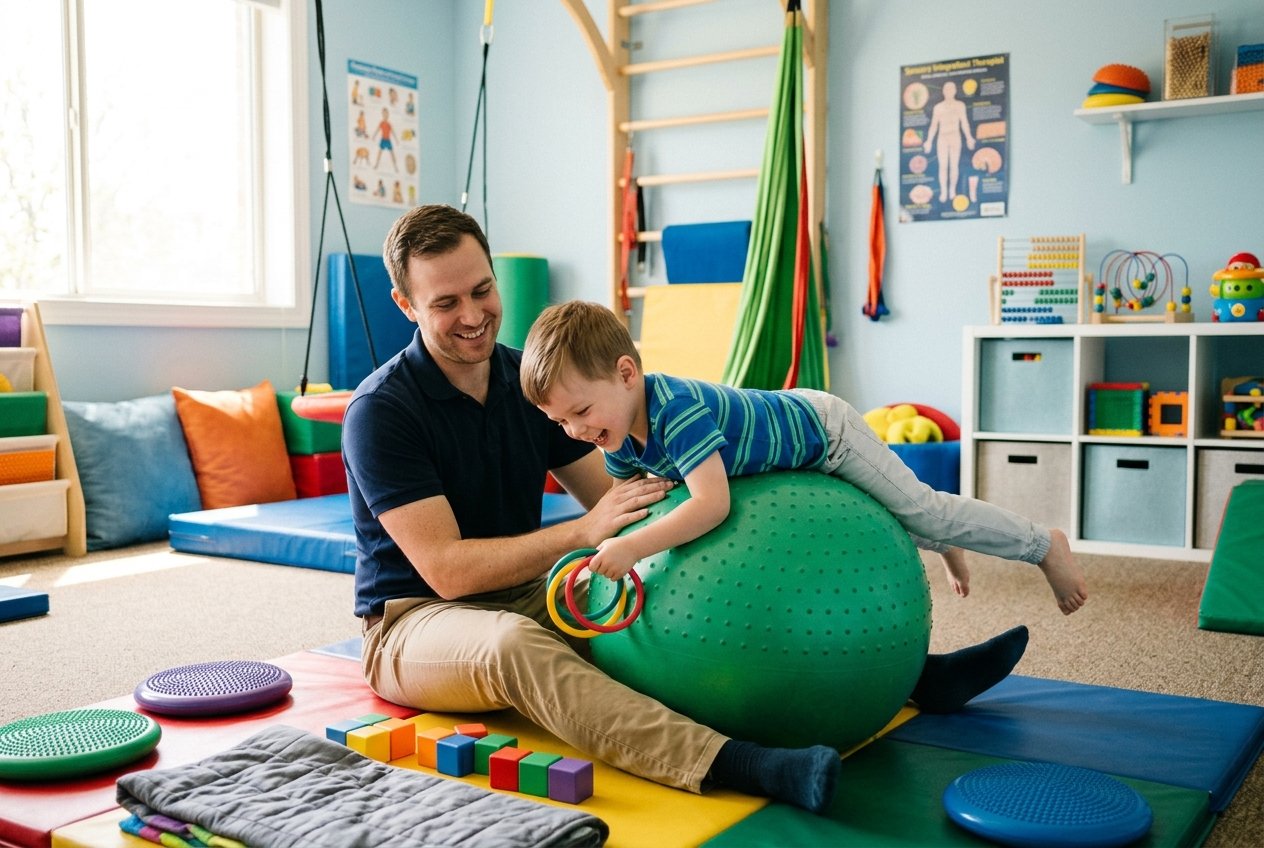
Many children on the Autism Spectrum (ASD) experience difficulties with motor coordination, balance, and motor planning, alongside sensory processing disorders. Physical therapy plays an important role in enhancing body awareness (proprioception), regulating sensory responses through vestibular and tactile exercises, and developing gross motor skills to build confidence and independence.
Pediatric Motor Therapy & Balance in Autism
Many children on the Autism Spectrum (ASD) experience difficulties with motor coordination, balance, and motor planning, alongside sensory processing disorders. Physical therapy plays an important role in enhancing body awareness (proprioception), regulating sensory responses through vestibular and tactile exercises, and developing gross motor skills to build confidence and independence.
Home Sensory-Motor Program for Autism
Home-based physical therapy for autism provides structured, purposeful physical activities in the comfort of a quiet, familiar home, away from the sensory overload of clinics. We utilize therapy balls, balance boards, and obstacle courses to organize the nervous system, improve muscle tone, and promote interactive play.
Home Physical Therapy Protocol
Sensory & Vestibular Stimulation
Using therapeutic bouncing and swinging to stimulate the vestibular system and enhance neuromuscular balance.
Motor Planning & Spatial Awareness
Structuring barrier-course activities (like jumping over blocks or walking along pathways) to enhance spatial and motor planning.
Core Strengthening & Posture Control
Strengthening trunk and back muscles to optimize sitting posture, preventing hypotonic slumping.
Advanced Coordination & Social Play
Training ball throw-and-catch, jumping, and imitation skills to facilitate school and sports integration.
Benefits of In-Home Therapy
Enhanced Motor Planning
Helping the child plan, sequence, and execute complex motor tasks with fluid coordination.
Sensory Regulation & Attention
Structured sensory input reduces repetitive behaviors (stimming) and increases attention span.
General Fitness & Health
Developing gross motor skills prevents secondary sedentary lifestyles and pediatric obesity.
Distraction-Free Environment
A home environment reduces anxiety and allows the therapist to use the child's own toys for training.
Book a Home Assessment for Your Child Now
Our home services cover all areas of Jeddah, Makkah, and Qatif.
Local Coordination & Clinical Pathways in Jeddah
📍 Coordinated through the Jeddah home-visit scheduling pathway
In Jeddah, our mobile physical therapy teams cover all major residential neighborhoods, including Al-Safa, Al-Naeem, Al-Rawdah, Al-Hamra, Al-Mohammadiyah, and Al-Zahra, traveling with portable clinical tools.
For post-surgical rehabilitation and complex neurological profiles, families are asked to share the latest medical reports and physician instructions so the home programme stays aligned with the treating doctor's restrictions.