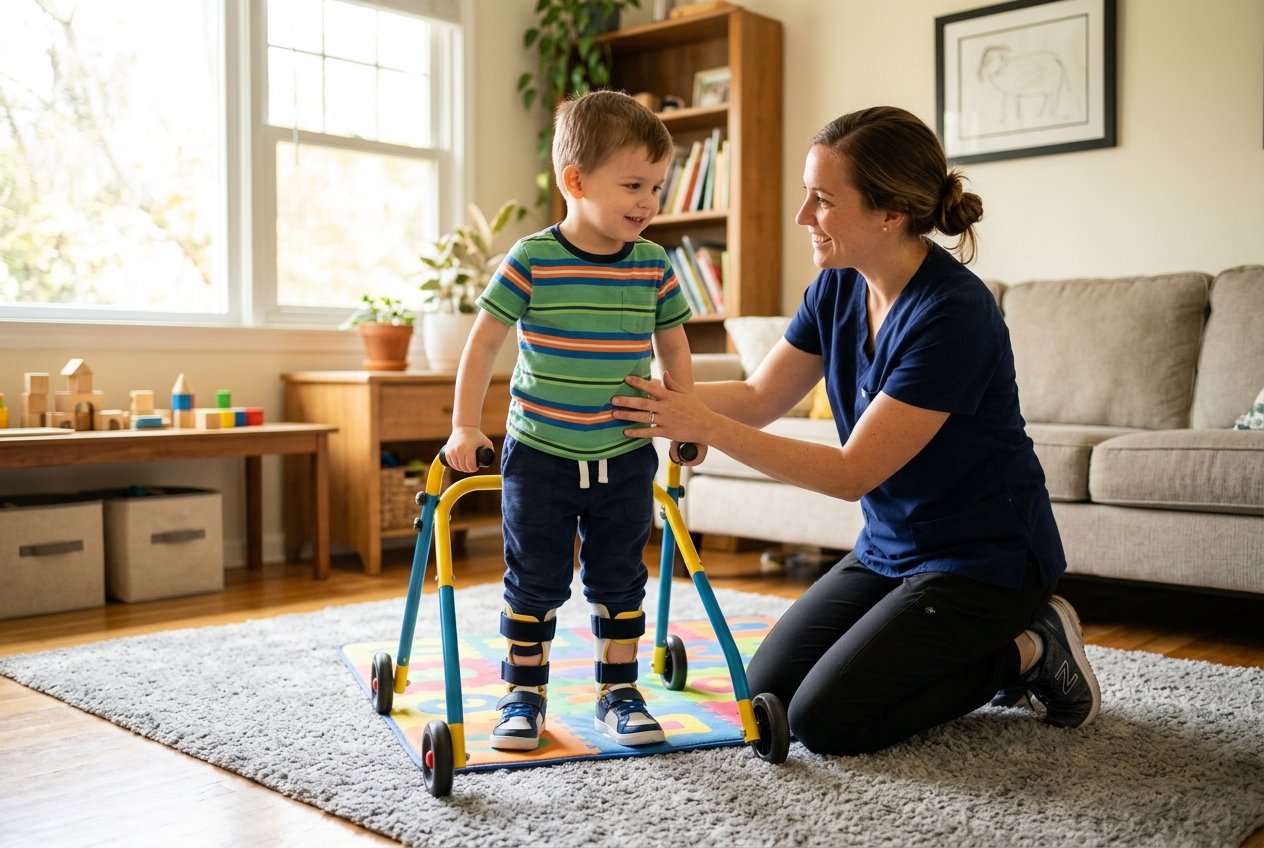
Spina Bifida is a congenital neural tube defect where the spine and spinal cord do not form properly. It results in varying degrees of lower extremity paralysis, muscle weakness, sensory deficits, and balance issues. Home physical therapy aims to maximize the child's functional independence by strengthening intact musculature, preventing joint deformities, and training wheelchair, walker, or orthotic navigation.
Understanding Spina Bifida and Motor Rehabilitation
Spina Bifida is a congenital neural tube defect where the spine and spinal cord do not form properly. It results in varying degrees of lower extremity paralysis, muscle weakness, sensory deficits, and balance issues. Home physical therapy aims to maximize the child's functional independence by strengthening intact musculature, preventing joint deformities, and training wheelchair, walker, or orthotic navigation.
Home Rehabilitation Plan for Spina Bifida
In the home environment, the therapist targets upper body and core strengthening to compensate for lower limb weakness. The program includes passive stretching to prevent contractures, transfers training (floor to chair/bed), and supported standing (via standing frames and KAFO braces) to promote bone density and bowel health.
Home Physical Therapy Protocol
Upper Body & Core Conditioning
Strengthening shoulder, arm, and back muscles to enable independent body transfers and wheelchair propulsion.
Contracture Prevention & ROM
Passive range of motion (ROM) and daily stretching of the hips, knees, and ankles to prevent joint deformities.
Transfers & Seating Balance
Teaching the child safe transfer techniques between the wheelchair, bed, and floor, while optimizing sitting balance.
Supported Standing & Gait Training
Using standing frames or long leg braces (KAFOs) to stand, and training gait with walking frames or crutches.
Benefits of In-Home Therapy
Maximizing Independence
Teaching the child how to manage transfers and mobility, reducing dependence on caregivers.
Bone & Joint Protection
Daily weight-bearing via standers prevents osteoporosis and joint stiffness.
Skin Integrity & Pressure Care
Teaching skin checks and pressure relief strategies to prevent sores in areas with sensory loss.
Functional Home Training
Training transfers on the child's actual bed, couch, and bathroom setup for practical daily success.
Book a Home Assessment for Your Child Now
Our home services cover all areas of Jeddah, Makkah, and Qatif.
Local Coordination & Clinical Pathways in Makkah
📍 Coordinated through the Makkah home-visit scheduling pathway
In Makkah, we cover Al-Awali, Al-Shawqiyyah, Al-Naseem, Al-Batha, Al-Zaidi, and Al-Aziziyah. We provide female clinical therapists to ensure maximum comfort and compliance in Makkah households.
For patients recently discharged after surgery or medical admission, the first visit starts with reviewing discharge instructions, movement precautions, and any warning signs that require physician follow-up.