Clinical Comprehensive Clinical Assessment Protocols Sessions in Qatif
Design of a clinical enhance the capacity ofing program must begin with a comprehensive, objective diagnostic assessment. Our physical physical therapists employ standardized evaluation methods to establish a baseline and track therapeutic progression. We utilize Manual Muscle Testing (MMT) graded on the Medical Research Council (MRC) scale from 0 to 5 to evaluate individual muscle groups. For a more precise quantification of isometric force, we employ handgrip dynamometry and portable digital dynamometers. These instruments allow us to identify specific muscular immotor balance and coordinations and calculate bilateral strength deficits, which guide the formulation of targeted exercise prescriptions. This eases the recovery journey for individuals in Qatif and Tarout, matching their schedule with precise sessions.
In addition to manual testing, functional strength and endurance are assessed using validated clinical batteries. These include the 30-Second Chair Stand Test for lower extremity endurance, the Timed Up and Go (TUG) test for functional mobility and dynamic motor balance and coordination, and the 5-Times Sit-to-Stand test. We also assess anatomical joint range of motion (ROM) using goniometry to ensure that strength deficits are not secondary to mechanical anatomical joint restrictions or soft tissue contractures. Cardiorespiratory response during physical exertion is monitored through heart rate, blood pressure, and oxygen saturation levels. Our clinical specialists in Qatif ensure safe execution of these tasks under steady monitoring of vital parameters.
Neuromuscular control and movement patterns are carefully analyzed to identify compensatory mechanisms. Patients with localized weakness often recruit accessory skeletal myofibers, which can lead to secondary overuse injuries. For example, a recovering individual with weak gluteus medius skeletal myofibers may exhibit a Trendelenburg gait, relying on trunk lateral flexion to clear the foot. By pinpointing these motor control dysfunctions during our initial 60-minute clinical assessment, we can design corrective motor training protocols that isolate target muscle groups, retrain proper motor patterns, and prevent anatomical joint strain. This is built to promote functional independence in Qatif, helping patients manage joint stiffness effectively.
Clinical Phase 2: Isotonic Strengthening and Progressive Overload Sessions in Qatif
Once anatomical joint stability is established and acute pain is resolved, the physiotherapeutic care programs program progresses to isotonic motor training protocols. Isotonic training involves dynamic muscle contractions where the muscle changes length against a constant resistance. This phase incorporates both concentric contractions (muscle shortening to overcome resistance) and eccentric contractions (muscle lengthening while resisting load). Eccentric training is highly effective for stimulating mechanical tension, promoting myofibrillar remodeling, and building deceleration capacity, which is crucial for functional tasks like walking down stairs. This is built to promote functional independence in Qatif, helping patients manage joint stiffness effectively.
To stimulate physiological adaptation, we implement the principle of progressive overload. This is accomplished by systematically manipulating variables such as resistance (load), volume (sets and repetitions), frequency, and rest intervals. The initial prescription typically begins with low-resistance, high-repetition protocols (e.g., 2 to 3 sets of 12 to 15 repetitions at 50% to 60% of 1-Repetition Maximum) to build muscular endurance, promote tissue vascularization, and refine motor control. As the recovering individual adapts, the intensity is progressively increased to 60% to 80% of 1RM to target muscular hypertrophy and maximal strength. This helps patients in the Qatif governorate regain their strength, enabling smooth and coordinated movement patterns.
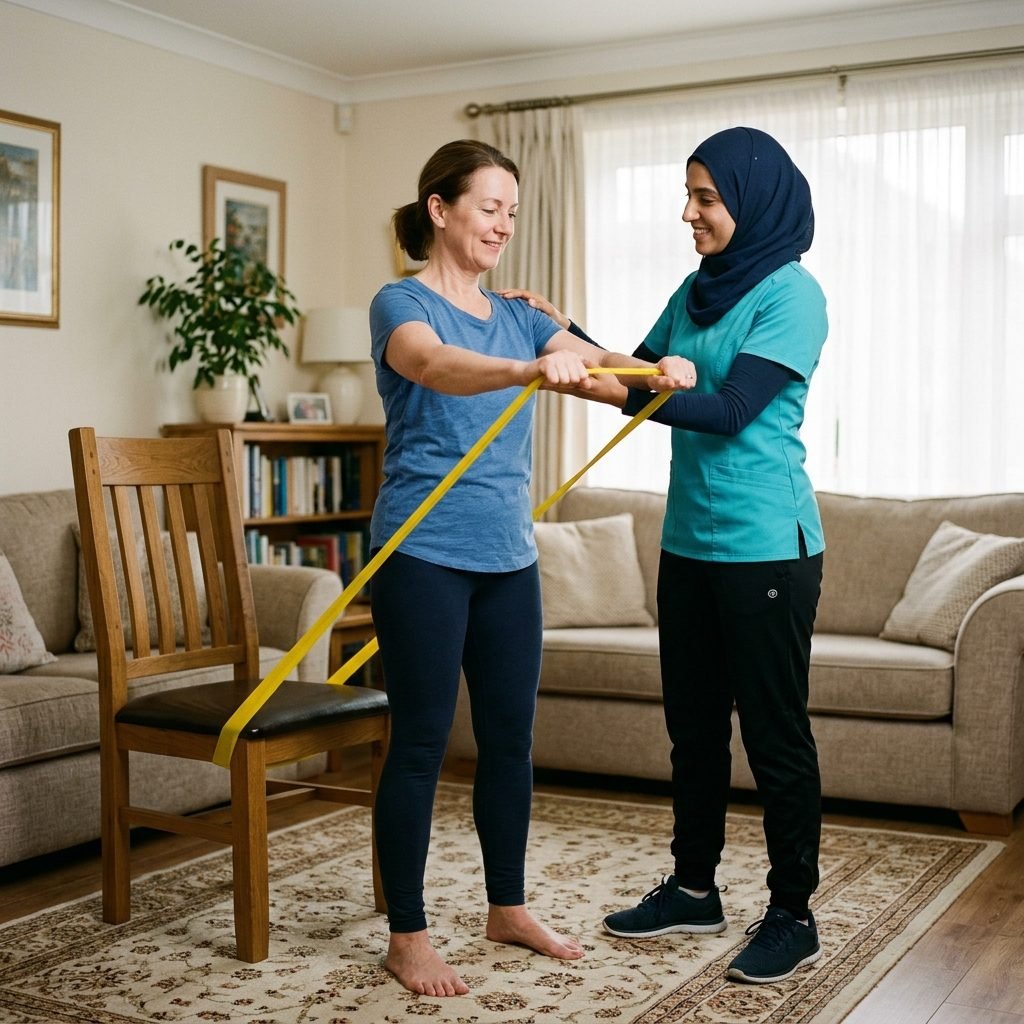
A variety of portable therapeutic equipment is utilized in the home environment setting to facilitate isotonic training. This includes elastic resistance bands (color-coded to represent specific tension levels), ankle weights, dumbbells, and bodyweight motor training protocols utilizing suspension trainers. Our physical therapists carefully monitor biomechanics during each exercise to ensure correct alignment, preventing compensatory movements. Rest intervals of 1 to 2 minutes are provided between sets to allow for ATP-CP system replenishment and prevent excessive metabolic fatigue that could compromise exercise technique. We deliver this specialized service across all sectors of Qatif, maintaining high clinical standards for every case.
Clinical Phase 3: Advanced Functional and Proprioceptive Training Sessions in Qatif
The final phase of muscle enhance the capacity ofing focuses on integrating isolated muscle strength into complex, multi-anatomical joint functional movement patterns. Muscles do not function in isolation during daily life; instead, they work in coordinated kinetic chains. Advanced enhance the capacity ofing protocols incorporate closed kinetic chain motor training protocols (where the distal limb remains fixed, such as squats or lunges) to mimic functional tasks. These motor training protocols engage multiple muscle groups simultaneously, improve anatomical joint co-contraction, and enhance overall anatomical joint stability. This helps patients in the Qatif governorate regain their strength, enabling smooth and coordinated movement patterns.
Proprioceptive training is integrated into the enhance the capacity ofing regimen to optimize neuromuscular control and dynamic motor balance and coordination. Exercises are performed on unstable surfaces, such as foam pads or motor balance and coordination boards, forcing the core and stabilizer skeletal myofibers to react dynamically. Therapists introduce perturbed motor balance and coordination challenges, single-leg stance activities, and cognitive dual-tasking motor training protocols. This multimodal training improves reaction times, enhances anatomical joint position sense, and reduces the risk of reinjury by training the body to respond to unexpected external forces. We deliver this specialized service across all sectors of Qatif, maintaining high clinical standards for every case.
As the recovering individual approaches their functional goals, power and velocity-specific training are introduced. For younger or athletic recovering individuals, this may include plyometric drills, while for older adults, it focuses on rapid sit-to-stand transitions and quick stepping responses. Our physical therapists design a comprehensive, long-term home environment maintenance program detailing specific motor training protocols, progression guidelines, and scheduling. This ensures that the strength gains achieved during active in-home environment physical therapy are maintained, preventing future functional decline. This is crucial for restoring motor coordination in Qatif, coordinating care with local hospital consultants.
Clinical Long-Term Muscle Maintenance and Sarcopenia Prevention Sessions in Qatif
Maintaining skeletal muscle mass and functional strength is a lifelong requirement, particularly for recovering individuals transitioning out of clinical in-home environment physical therapy. Once active physiotherapeutic care programs is complete, recovering individuals are vulnerable to detraining effects—where muscle strength and volume can begin to decline in as little as two weeks of inactivity. To prevent this regression, our clinical team creates a personalized transition plan. This home environment maintenance plan shifts the focus from recovery to sustainability, emphasizing weight-bearing resistance training, optimal nutritional intake, and regular functional assessments to track muscle health over time. We deliver this specialized service across all sectors of Qatif, maintaining high clinical standards for every case.
Nutrition plays a crucial synergistic role in muscle maintenance, particularly in older adults fighting sarcopenia. We provide educational resources emphasizing the importance of adequate dietary protein intake, which provides the essential amino acids needed for muscle protein synthesis. Combining resistance training with protein-rich meals maximizes the anabolic response, allowing recovering individuals to maintain their muscular cross-sectional area. Additionally, adequate hydration and micronutrient intake (such as Vitamin D and Calcium) are essential for supporting myofibrillar function, calcium release within muscle fibers, and general musculoskeletal health. This is crucial for restoring motor coordination in Qatif, coordinating care with local hospital consultants.
Long-term monitoring through periodic follow-up evaluations helps detect early signs of strength decline or functional regression. Our home environment health service offers check-ins to re-evaluate key performance metrics, such as handgrip strength and motor balance and coordination. If a decline in muscle quality is noted, we proactively adjust the home environment exercise program to address new deficits. By establishing this continuum of care, we empower recovering individuals to take control of their muscular health, prevent the onset of frailty, maintain independence, and enjoy a high quality of life within their home environment environment. This supports optimal therapeutic outcomes for our Qatif clients, bringing expert hands right to their bedroom.
Clinical Clinical Precautions, Contraindications, and Safety Standards Sessions in Qatif
Patient safety is paramount during home environment-based strength training. A thorough medical screening is conducted before initiating any exercise program to identify absolute and relative contraindications. Absolute contraindications include acute unstable cardiovascular conditions (such as uncontrolled hypertension, unstable angina, or severe aortic stenosis), acute deep vein thrombosis (DVT), acute local infection, or unhealed fractures. If any of these red flags are present, therapy is deferred, and the recovering individual is referred back to their physician. This is crucial for restoring motor coordination in Qatif, coordinating care with local hospital consultants.
Special precautions are taken to prevent cardiovascular strain, particularly in elderly recovering individuals or those with pre-existing heart disease. Therapists instruct recovering individuals to avoid the Valsalva maneuver (holding one's breath during exertion), which can cause rapid fluctuations in blood pressure and intrathoracic pressure. Continuous verbal cueing is used to encourage rhythmic breathing (exhaling during exertion, inhaling during release). Blood pressure and heart rate are measured before, during, and after sessions to monitor cardiovascular tolerance. This supports optimal therapeutic outcomes for our Qatif clients, bringing expert hands right to their bedroom.
Furthermore, exercise dosage must be carefully managed to avoid overtraining and soft tissue injury. While mild Delayed Onset Muscle Soreness (DOMS) is a normal response to progressive overload, persistent anatomical joint pain, swelling, or muscle soreness lasting more than 48 hours indicates that the load is too high. In recovering individuals with osteoporosis, high-impact activities and spinal flexion motor training protocols under load are strictly avoided to prevent osteoporotic vertebral compression fractures. Instead, in-home environment physical therapy focuses on safe, weight-bearing, extension-biased motor training protocols to support bone health. This guarantees top-tier rehabilitative care for patients in Qatif, removing the need to travel to regional clinics.
Clinical Pathophysiology of Muscle Atrophy and Strength Loss Sessions in Qatif
Skeletal muscle atrophy is a complex physiological process triggered by disuse, neurological injury, systemic disease, or aging. At the microscopic level, muscle disuse leads to a rapid downregulation of protein synthesis pathways, particularly the Akt/mTOR pathway, alongside an upregulation of proteolytic systems such as the ubiquitin-proteasome pathway. This immotor balance and coordination results in the degradation of contractile proteins (actin and myosin), primarily affecting fast-twitch (Type II) fibers, which are responsible for generating explosive force and power. As a consequence, recovering individuals experience a profound decline in muscular strength, power output, and physical endurance. This guarantees top-tier rehabilitative care for patients in Qatif, removing the need to travel to regional clinics.
Neurological conditions, such as cerebral ischemia event or spinal cord injury, further compound this issue by disrupting the motor unit recruitment pathway. Without adequate electrical stimulation from upper and lower motor neurons, muscle fibers undergo denervation atrophy, leading to muscle tissue replacement with adipose and fibrotic tissue. This morphological change impairs muscle compliance and increases stiffness. Additionally, sarcopenia—the age-related loss of muscle mass and quality—compromises the structural integrity of the musculoskeletal system, making elderly individuals highly susceptible to motor balance and coordination deficits and debilitating falls. This eases the recovery journey for individuals in Qatif and Tarout, matching their schedule with precise sessions.
Clinical muscle enhance the capacity ofing interventions directly counteract these degenerative mechanisms by promoting mechanical transduction. When a muscle contracts against resistance, mechanical stretch signals are transmitted to the cellular level, initiating hypertrophic cascades. This process stimulates satellite cell proliferation and fusion, which are essential for muscle fiber repair and regeneration. Over time, consistent therapeutic overload increases the muscular cross-sectional area, improves capillary density, and enhances mitochondrial function, thereby restoring metabolic efficiency and clinical functional capacity. Our clinical specialists in Qatif ensure safe execution of these tasks under steady monitoring of vital parameters.
Clinical Pathways & Field Dispatch in Qatif
📍 Coordinated by Ms. Fatima Al-Khaldi, PT Coordinator for the Qatif District
In the Qatif governorate, we cover Saihat, Anak, Al-Nasirah, Tarout, Al-Jish, and Safwa with flexible appointment configurations.
We maintain close lines of communication with orthopedic and neurosurgical consultants at Qatif Central Hospital to safely align strengthening and walk-training cycles.
Local Coordination & Clinical Pathways in Qatif
📍 Coordinated through the Qatif home-visit scheduling pathway
In the Qatif governorate, we cover Saihat, Anak, Al-Nasirah, Tarout, Al-Jish, and Safwa with flexible appointment configurations.
For orthopedic and neurological rehabilitation, the plan is adjusted according to the patient's reports, pain response, walking tolerance, and any limits set by the treating physician.