01A Home-Visit Team, Not a Walk-In Clinic
Bidayah operates around a fully home-based physiotherapy model. Patients are not received inside a traditional outpatient clinic; instead, the therapist travels to the patient's home after the visit is coordinated and the primary clinical need is understood. This makes the team structure different from a standard clinic, because the therapist must combine clinical reasoning with field judgment: reading the home environment, adjusting exercises to available space, and teaching the family how to support safe movement between visits.
This page does not publish individual staff names, personal license numbers, or unverifiable claims. Its purpose is to explain the system the team follows: initial triage, in-home assessment, treatment planning, therapist-patient gender matching, progress review, and escalation when warning signs require medical attention. Any future personal profile or credential detail must be approved by the relevant person and supported by reliable documentation before publication.
02Matching the Therapist to the Patient
Therapist matching is not based only on schedule availability. The team first considers the type of case: neurological rehabilitation after stroke, post-operative mobility, older-adult balance work, paediatric motor delay, lymphatic swelling, or musculoskeletal pain. The patient is then matched with a clinician whose experience fits that field, while also respecting privacy: male patients are treated by male physiotherapists, and female patients are treated by female physiotherapists whenever in-home care is arranged.
The matching process also considers mobility level, use of assistive devices, family involvement, and safety risks inside the home. A patient who needs transfer training from bed to chair requires a different session structure from a patient with sciatica who needs education, graded movement, and nerve-sensitive exercise. The first visit therefore confirms clinical fit and safety instead of jumping into generic exercises.
03What Happens Before the Visit
Before the therapist travels to the home, the coordination process gathers essential information: diagnosis, reason for referral, city or neighborhood, available reports, relevant medications, recent surgery precautions, and the patient's current movement limitations. This information is not used to promise a fixed number of sessions or a guaranteed outcome. It simply helps the team avoid a random start and decide whether the case is suitable for home assessment or should first be reviewed urgently by a physician.
Families are asked to prepare discharge summaries, imaging reports, or physician instructions when available, and to provide a safe area for movement. The team also clarifies that in-home physiotherapy does not replace medical diagnosis and does not provide remote diagnosis. It supports a safe rehabilitation plan when the patient's medical status is stable. If important information is missing or red flags appear, intensive exercise is delayed until medical direction is clear.
04How the Session Is Structured
During the home session, the therapist reviews pain, range of motion, balance, muscle strength, transfer ability, walking pattern, and use of assistive devices. Treatment then focuses on a nearby functional goal: standing safely, improving walking steps, reducing joint stiffness, strengthening weak muscles, or teaching the family how to help without pulling, lifting incorrectly, or increasing fall risk. The same diagnosis can present with very different levels of weakness or fear of movement, so the plan must be individualized.
The session also respects the patient's tolerance. If pain increases sharply, dizziness occurs, or fatigue becomes unusual, the therapist reduces intensity or stops the unsuitable task. Good home exercise is not necessarily hard exercise; it is exercise that can be repeated safely between visits. That is why the therapist leaves simple instructions on what may be repeated, what should be avoided, and when the family should contact the coordinator or physician before continuing.
05Family and Caregiver Education
Family members are part of the home rehabilitation environment, especially for older adults, stroke survivors, children, and bedridden patients. The therapist teaches safe assistance with standing, walker use, room organization, fall-risk reduction, and supportive encouragement without rushing or pressuring the patient. When caregivers understand the purpose of each exercise, sessions become more consistent and unsafe habits become less likely.
Family involvement does not transfer clinical responsibility to relatives. Treatment decisions remain with the therapist, with physician coordination when needed. The family role is practical daily support: noticing changes, keeping the environment safe, and helping the patient repeat appropriate home tasks. The team therefore prefers fewer clear instructions over a long list that overwhelms the patient and caregiver.
06Limits of Home Physiotherapy
The team does not promise full recovery, fixed treatment duration, or a universal number of sessions. Outcomes depend on diagnosis, age, associated medical conditions, exercise adherence, medical stability, and whether the problem is neurological, musculoskeletal, post-surgical, paediatric, or age-related. Instead of promising cure, the plan uses measurable goals such as improving joint range, reducing fall risk, increasing walking tolerance, or making transfers safer.
Some signs are not appropriate for routine home exercise. Sudden chest pain, severe breathlessness, new loss of bladder or bowel control with nerve pain, rapidly worsening limb weakness, unexplained fever after surgery, or signs of deep vein thrombosis require urgent medical review. In these situations, the team must stop exercise and direct the family toward medical care rather than treating the signs as normal rehabilitation discomfort.
07Clinical Review and Content Integrity
The site's medical pages describe general principles of home physiotherapy and do not replace individual examination. When pages discuss stroke, sciatica, Parkinson's disease, post-operative rehabilitation, or paediatric movement concerns, the language avoids unsupported success rates and unrealistic guarantees. Medical trust is not built by exaggeration; it is built by clear boundaries, careful wording, and respect for the differences between patients.
The same thinking applies inside the service workflow. The team asks whether the goal is suitable, whether the exercise is safe, whether the patient needs referral, whether the family understands the instructions, and whether the condition has changed since the last visit. These questions prevent repetitive automatic treatment and encourage the clinician to update the plan when the patient's response changes.
08Portable Tools and Practical Home Training
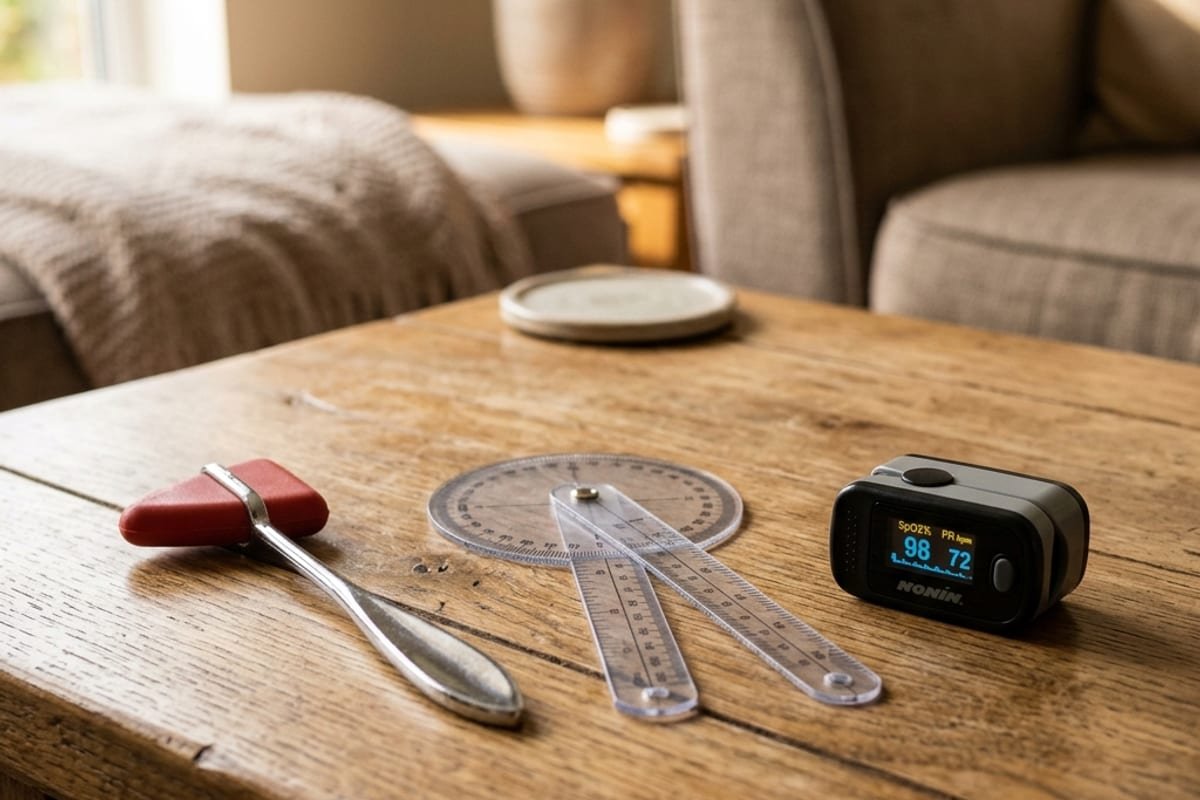
Therapists may bring light portable tools such as resistance bands, movement-measurement tools, balance aids, and exercise education materials. Having tools does not mean using every item in every visit. Selection depends on the case goal, the home's available space, and safety. Sometimes the best intervention is not a device at all, but teaching a safer chair height, a better transfer pattern, or a short walking routine that the family can support.
Portable equipment supports clinical reasoning but does not replace it. After surgery, the therapist respects weight-bearing and range-of-motion precautions. In neurological rehabilitation, fatigue, balance, and motor control are monitored closely. In paediatric therapy, tools become structured play that helps the child move with less fear. The tool serves the goal; the goal does not serve the tool.
09How Patients Can Recognize a Good Fit
A good fit begins with a clear assessment. The patient and family should understand why certain exercises were chosen, what each phase is trying to achieve, and which signs require stopping or contacting the team. Privacy should be respected, medical questions should be taken seriously, and the plan should make sense inside the patient's real home rather than only on paper. These small details are often what make home rehabilitation sustainable.
A second sign of a good fit is that the team does not treat every pain or weakness the same way. Sciatica differs from knee stiffness after surgery, which differs from older-adult balance decline or delayed walking in a child. Bidayah's team model is built around organized, calm, adjustable care that respects each patient's individual clinical picture. This page explains that method; the exact plan belongs to the direct in-home assessment.
10Monitoring Progress Between Visits
The team's responsibility does not end when the therapist leaves the home. After each visit, the patient and family should understand what changed, which exercise continues, and which marker will be reviewed next time. The marker may be more steps in the corridor, less assistance during standing, improved joint range, or reduced fear during bed-to-chair transfer. Clear markers help the patient feel that the plan is moving toward measurable function instead of repeating sessions without a visible reason.
Between-visit follow-up also includes the home environment. If the patient begins walking more, the corridor may need clearer space, rugs may need securing, or the chair position may need adjustment. If new pain or unusual fatigue appears, the family should know when to stop exercise and contact the team. This kind of follow-up extends the therapist's value through education and guidance, not only through the minutes spent in the session.
11Transparent Communication and Family Expectations
Families need honest language about improvement. It is not appropriate to promise that every case will recover within a fixed number of sessions, but it is also unhelpful to leave the family without measurable expectations. The team therefore explains the difference between near goals and later goals: safe standing may come first, longer walking may follow, and daily tasks such as bathroom access or sitting for meals may become the next focus. Breaking the goal into stages makes the journey easier to understand.
Transparency also means acknowledging when the patient needs medical input or an additional report. If surgical instructions are unclear, swelling is unexplained, or weakness worsens quickly, the professional response is to request medical review rather than continue exercising. This protects family trust and shows that home physiotherapy works within a wider care pathway, not as a service separated from patient safety.