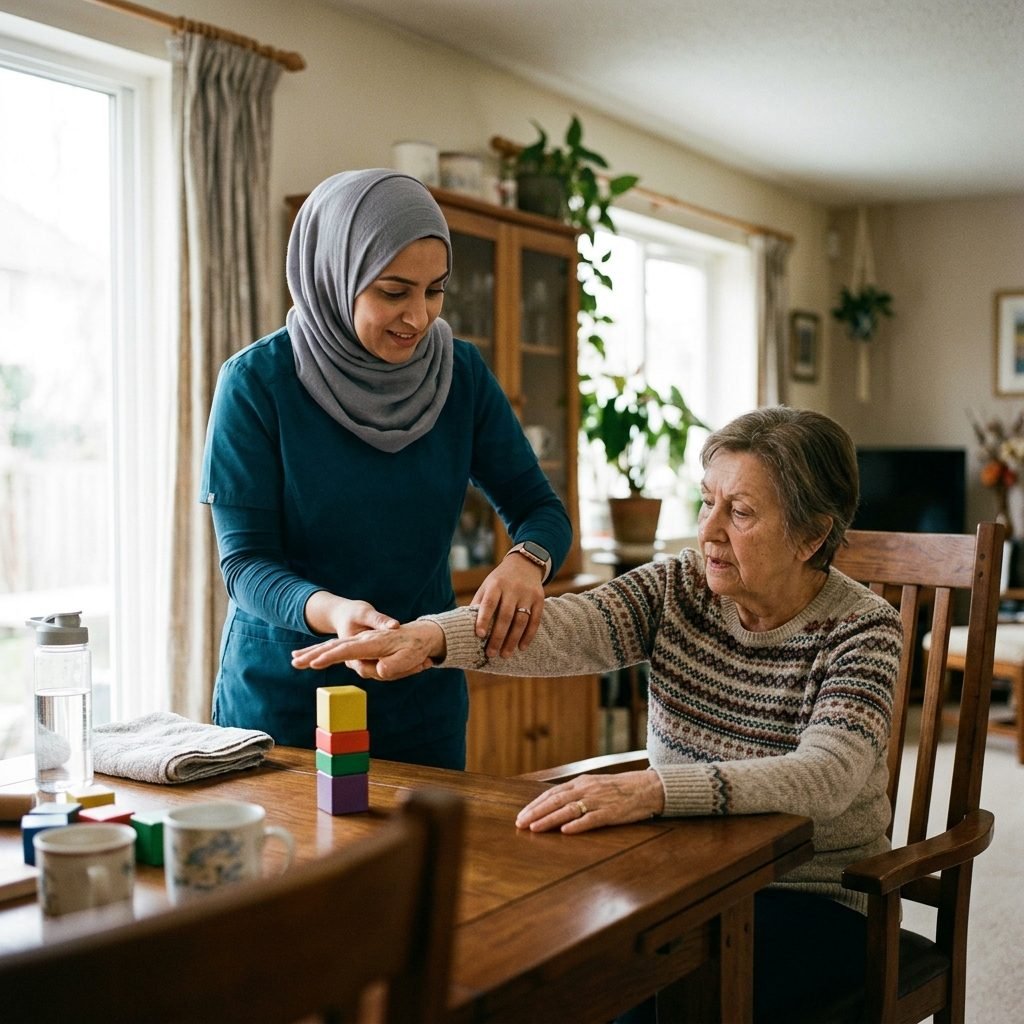
Having access to comprehensive, clinical physical therapy at home is crucial for maintaining rehabilitation progress, especially in busy neighborhoods. Al-Safa and Al Fayha districts in Jeddah present unique local mobility challenges due to high population density and traffic. At Bidaya Center, we deliver high-quality home physiotherapy and movement rehabilitation services directly to your doorstep, conforming to the clinical guidelines of the Saudi Commission for Health Specialties. We eliminate the stress of travel, traffic, and parking. We respect cultural privacy by providing certified male therapists for male patients and female therapists for female patients.
Our clinical approach in Al Fayha starts with a detailed physical and environmental safety assessment to eliminate fall hazards in the home. We bring all necessary portable, sterilized equipment to deliver a clinical standard of care comparable to external clinics. The therapist establishes a tailored milestone tracking plan to monitor muscle strength, balance, and joint range of motion (ROM) progression over time.
Why families in Al Fayha choose Bidaya for home physiotherapy
- ✅ Licensed male & female therapists — full privacy, in your own home in Al Fayha.
- ✅ Fully in-home visits across Al Fayha — no travel or traffic.
- ✅ A personalized rehab plan built after a thorough in-home assessment.
- ✅ Continuous follow-up and direct contact with your therapist throughout.
- ✅ Fast response — arrange your visit by a quick call or WhatsApp message.
We also serve nearby areas: Al Andalus · Al Basateen · Al Bawadi
* The treatment plan and expected outcomes are determined by a medical and functional assessment of each individual case.
Home-Based Post-Stroke Rehabilitation and Why It Matters for Al Fayha Residents
A stroke arrives without warning and reshapes the rhythm of an entire family within minutes. It can leave weakness on one side of the body, difficulty walking, trouble with speech, or a loss of balance and coordination. Home-based post-stroke rehabilitation is a structured therapy program designed to retrain both the brain and the body, drawing on the nervous system's ability to rebuild its pathways and relearn movement through guided, consistent repetition.
In Al Fayha, Jeddah, a calm, family-oriented residential neighborhood, many households find it genuinely difficult to transport a loved one to a center over and over again, especially in the early weeks when moving around is exhausting and carries a real risk of falling. This is where the home service proves its worth: a licensed physiotherapist comes to the door, and the patient trains within their own natural environment, on the beds, chairs, bathroom, and stairs they actually use every single day.
That closeness to daily reality makes rehabilitation more practical and its effect faster, because the skills the patient learns are applied directly in the place where they are needed. It also spares the family in Al Fayha the strain of scheduling, waiting rooms, and repeated trips, while giving the patient a sense of safety that lowers anxiety and encourages a greater effort in every session.
Symptoms and Signs That Call for Starting
Beginning rehabilitation early, once the medical condition has stabilized, is an important factor. The presence of any of the following signs after a stroke means your relative is a candidate for a structured home rehabilitation program:
- Weakness or paralysis on one side of the body that makes lifting the arm or moving the leg difficult or impossible.
- Difficulty walking or standing, loss of balance, and leaning toward one side while sitting or moving.
- Muscle stiffness and increased tone (spasticity) that makes bending or straightening a joint hard.
- Reduced control of the hand and fingers, affecting grip and the ability to perform fine tasks.
- Slurred speech or swallowing difficulty that needs monitoring and coordination with the relevant specialties.
- Numbness or loss of sensation in the affected limb, and neglect of that side during daily activities.
- Near-total dependence on others to move from bed to chair or to enter the bathroom.
- Persistent inactivity after hospital discharge, with a fear of falling that stops the patient from trying.
The appearance of one or more of these signs does not, on its own, define the shape of the program. The precise plan, the type of exercises, and the order of priorities are built after a direct clinical and functional assessment of the patient's condition and current abilities.
Conditions and Groups Who Benefit
Home-based post-stroke rehabilitation in Al Fayha is directed at a broad range of patients whose needs vary according to the location and severity of the injury:
- Patients recovering from either hemorrhagic stroke or stroke caused by a blocked vessel, once stable and discharged from hospital.
- Those with hemiparesis, weakness on one side of the body, who need to retrain movement and balance.
- Older adults for whom frequent travel is a burden and who prefer to receive therapy in familiar surroundings.
- Patients in the post-critical-care stage who need daily follow-up to prevent complications such as joint stiffness and pressure sores.
- People whose stroke happened a long time ago and whose progress has plateaued, needing a fresh, purposeful program.
- Patients dealing with muscle spasticity or a limited range of joint motion after the injury.
- Individuals working to regain independence in daily activities such as dressing, eating, transferring, and using the bathroom.
Each of these groups follows a different path. A patient in the first weeks is entirely different from someone whose injury is months old, which is why we rely on an individual assessment to set a realistic starting point and achievable goals for each person separately.
Goals of the Rehabilitation Program
The rehabilitation program is built around clear, measurable goals that are reviewed and adjusted as the patient progresses. Among the main things we work toward:
- Improving muscle strength on the affected side and gradually reactivating voluntary movement.
- Restoring balance and control of body posture while sitting, standing, and transitioning between positions.
- Retraining a safe, steady walking pattern while reducing dependence on assistance as much as possible.
- Easing muscle spasticity, preserving joint range of motion, and preventing stiffness.
- Improving fine hand skills and motor coordination to restore the performance of daily tasks.
- Preventing complications linked to immobility, such as pressure sores, limb clots, and a frozen shoulder.
- Raising the level of independence in daily living and lightening the care burden on the family.
- Supporting the patient's self-confidence and psychological motivation to continue the recovery journey.
We stress that goals are framed realistically and that we make no promises of guaranteed results. The degree and speed of improvement depend on the nature of the injury, the patient's general condition, and their commitment to the program, and they are defined precisely only after the clinical and functional assessment.
Stages and Path of the Home Sessions
Home rehabilitation in Al Fayha follows a gradual path that respects the patient's capacity and never rushes the stages:
- Initial assessment: during the first visit the therapist carries out a thorough examination of strength, balance, range of motion, and task ability, discusses medical history and priorities with the family, then sets a preliminary plan.
- Foundation stage: focuses on passive and active range-of-motion exercises, correct positioning in bed, muscle activation, and prevention of early complications.
- Capacity-building stage: targeted strengthening exercises, training on sitting and balance, transferring from bed to chair, and beginning safe weight-bearing.
- Function and walking stage: retraining the gait, balance during movement, going up and down, and improving hand use in daily tasks.
- Independence and integration stage: applying the skills in real-life situations inside the home, gradually reducing assistance, and consolidating the gains.
The length of each session and the number of weekly sessions are set according to the patient's condition and tolerance, and the therapist runs periodic reviews to measure progress and adjust the exercises. Each stage builds on the one before it, and we do not move a step forward before confirming that the gains are stable.
The Role of the Family and Caregiver
The family is a core partner in the success of rehabilitation, and its active involvement in Al Fayha makes a large difference between a session that ends and is forgotten and a program the patient lives out throughout the day. The caregiver's role includes:
- Helping the patient perform the prescribed exercises between sessions in the correct way the therapist has explained.
- Encouraging the patient to use the affected side in daily tasks rather than relying entirely on the unaffected side.
- Following the schedule of correct positioning and repositioning the patient regularly to prevent pressure sores.
- Watching for any changes in the patient's condition, such as numbness, redness, or pain, and reporting them to the therapist.
- Creating a safe, encouraging home environment that lets the patient try and move without excessive fear.
- Offering emotional support and patience, because recovery is a long journey that may include swings in mood and motivation.
The therapist makes a point of training family members hands-on in safe transfer methods and correct support, so they become an extension of the therapy program rather than mere observers. This cooperation speeds up progress and preserves the gains between visits.
Home Safety and Prevention Tips
The patient's safety inside the home is a priority no less important than the exercises themselves, especially with impaired balance after a stroke. We advise families in Al Fayha to consider the following:
- Remove loose rugs, cables, and obstacles from the patient's walkways to reduce the risk of tripping.
- Ensure good lighting in rooms and hallways, especially on the route to the bathroom at night.
- Install fixed grab bars near the toilet and in the bathroom, and use a shower chair when needed.
- Choose closed, stable, non-slip footwear instead of loose slippers inside the house.
- Organize medications and their timing, and monitor blood pressure and diabetes as directed by the treating physician.
- Reposition a bedbound patient regularly and keep the skin moisturized to guard against pressure sores.
- Never pull or tug the affected arm during transfers, to avoid shoulder injury.
- Maintain light, regular physical activity within the patient's limits and avoid long periods of sitting without movement.
These preventive measures reduce complications and protect the gains, but they are no substitute for specialist supervision. The therapist assesses your home and suggests the modifications suited specifically to your relative's condition.
Frequently Asked Questions (FAQ)
When should we begin home rehabilitation after a stroke?
It is best to start as soon as the medical condition has stabilized and the treating physician approves, because the early weeks are important for regaining function. Even so, patients whose injury happened long ago can benefit from a well-designed program, and the right timing is determined after assessment.
Is home rehabilitation as effective as rehabilitation centers?
Home rehabilitation offers the advantage of training the patient in their real environment on the tasks they need each day, with greater privacy and comfort. Its effectiveness depends on the regularity of sessions and the commitment of the patient and family to the plan, and it can be coordinated alongside any other medical follow-up.
Are female therapists available for female patients?
Yes, both male and female licensed therapists are available, and a female therapist can be assigned for female patients with full privacy guaranteed inside the home, in a way that puts the patient and her family at ease.
How many sessions does a patient need per week?
There is no single number that suits everyone; the number and length of sessions are set according to the severity of the injury, the patient's tolerance, and the program's goals. The schedule is drawn up after the initial assessment and reviewed periodically as the case progresses.
Do you guarantee the patient's recovery and full return of movement?
We make no promises of guaranteed results, because the extent of recovery differs from case to case depending on the location and severity of the injury, the general condition, and commitment to the program. What we do commit to is a structured, evidence-informed plan aimed at achieving the greatest possible improvement, built on a careful clinical and functional assessment.
To book or ask about home-based post-stroke rehabilitation in Al Fayha, Jeddah, contact Bidaya Center by phone or WhatsApp by clicking Call Now, and our team will be glad to arrange a home visit and provide an initial consultation for your relative's condition.
Important Home Visit Details:
- ✓Setup: Please clear a 2x2m space in the room for safety.
- ✓Clothing: Wear loose, comfortable clothes for easy movement.
- ✓Therapist Parity: Male therapists for males, females for females.
- ✓Medical Reports: Keep your MRI or doctor reports ready for evaluation.
Rehabilitation & Services in Al Fayha
Stroke Rehabilitation
Advanced motor and neurological stroke recovery at home in Al Fayha.
Service Details ←
Geriatric Physical Therapy
Balance training, strengthening, and fall prevention for seniors in Al Fayha.
Service Details ←
Female Physiotherapist
Licensed female therapists providing home care for women in Al Fayha.
Service Details ←