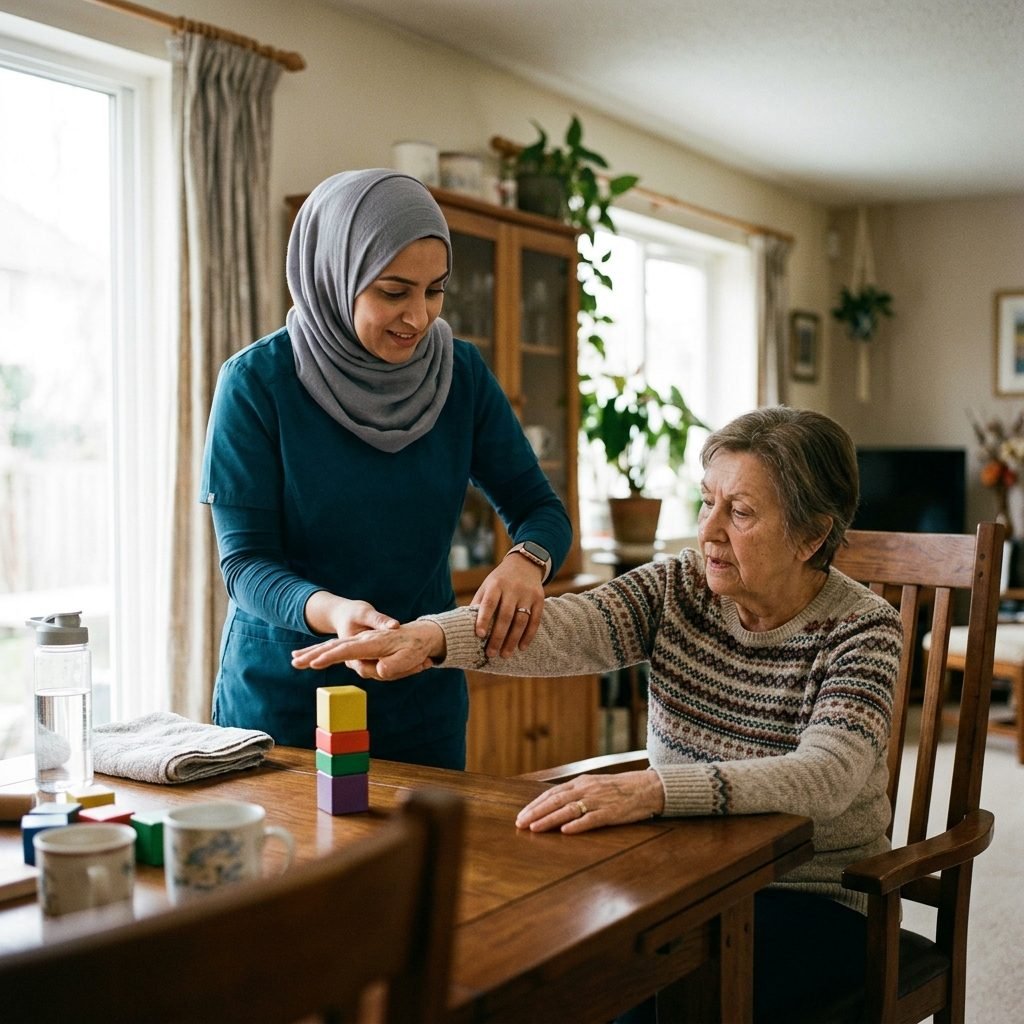
Having access to comprehensive, clinical physical therapy at home is crucial for maintaining rehabilitation progress, especially in busy neighborhoods. Al-Safa and Al Khaldiyah districts in Jeddah present unique local mobility challenges due to high population density and traffic. At Bidaya Center, we deliver high-quality home physiotherapy and movement rehabilitation services directly to your doorstep, conforming to the clinical guidelines of the Saudi Commission for Health Specialties. We eliminate the stress of travel, traffic, and parking. We respect cultural privacy by providing certified male therapists for male patients and female therapists for female patients.
Our clinical approach in Al Khaldiyah starts with a detailed physical and environmental safety assessment to eliminate fall hazards in the home. We bring all necessary portable, sterilized equipment to deliver a clinical standard of care comparable to external clinics. The therapist establishes a tailored milestone tracking plan to monitor muscle strength, balance, and joint range of motion (ROM) progression over time.
Why families in Al Khaldiyah choose Bidaya for home physiotherapy
- ✅ Licensed male & female therapists — full privacy, in your own home in Al Khaldiyah.
- ✅ Fully in-home visits across Al Khaldiyah — no travel or traffic.
- ✅ A personalized rehab plan built after a thorough in-home assessment.
- ✅ Continuous follow-up and direct contact with your therapist throughout.
- ✅ Fast response — arrange your visit by a quick call or WhatsApp message.
We also serve nearby areas: Al Andalus · Al Basateen · Al Bawadi
* The treatment plan and expected outcomes are determined by a medical and functional assessment of each individual case.
What Home-Based Hemiplegia Rehabilitation Means for Al Khaldiyah Residents
Hemiplegia is the weakness or loss of movement and sensation on one side of the body, right or left, caused by an injury to the opposite side of the brain. It most often follows a stroke or brain haemorrhage, but can also result from head trauma, certain tumours, or infections. Hemiplegia rehabilitation is a structured therapy programme that retrains the brain and body to recover lost movement or to compensate for it, drawing on the principle of neuroplasticity: the nervous system's ability to build new pathways whenever purposeful practice is repeated at a sufficient dose.
When this rehabilitation is delivered in a patient's home in Al Khaldiyah, Jeddah, the session takes place inside the very environment the person actually lives in. Al Khaldiyah is an established, upscale residential district characterised by villas, family apartments, and multi-storey homes. This means the real challenge for someone with hemiplegia is not simply lifting an arm in a clinic, but getting out of their own bed, crossing the hallway, climbing the stairs to an upper floor, and reaching the bathroom safely. Home rehabilitation makes each of these tasks a direct part of the training rather than leaving them as abstract goals.
The value of home therapy for Al Khaldiyah families goes beyond comfort. Transporting a patient with weakness down a whole side of the body through traffic several times a week is exhausting, raises the risk of falls, and drains the family's energy. A home session removes that burden and lets the therapist see the real obstacles: the height of the bed, the firmness of the sofa, the layout of the bathroom, and the type of flooring. We maintain complete privacy inside the home, and both licensed male and female therapists are available so each family can choose what suits them. The path of recovery and its realistic ceiling always depend on a careful clinical and functional assessment of each individual case, with no promise of a guaranteed result.
Symptoms and Signs That Signal It Is Time to Start
The earlier rehabilitation begins after the medical condition has stabilised, the wider the window to benefit from neurological recovery. We encourage Al Khaldiyah residents to contact us when they notice any of the following on one side of the body:
- Clear weakness or heaviness in the arm or leg on one side, making it hard to lift or move the limb.
- Difficulty walking, dragging of the foot, or the body leaning and drifting toward the affected side.
- Loss of balance and a feeling of unsteadiness when standing, changing position, or turning.
- Stiffness and tightness in the muscles of the affected limb (spasticity), or conversely excessive floppiness.
- Weak hand grip and difficulty holding objects or performing fine tasks such as writing or fastening buttons.
- Numbness, tingling, or altered sensation to heat and cold on the affected side.
- Neglect of the affected side, or forgetting to use the arm even when some movement remains.
- Associated difficulties with swallowing, speech, or facial expression on the affected side.
Having one or more of these signs does not by itself define a fixed level of disability, but it is reason enough to request a specialist assessment. Delaying the start can allow faulty movement patterns and joint deformities to become entrenched and harder to correct later.
Conditions and Groups That Benefit
Our home hemiplegia rehabilitation service in Al Khaldiyah is designed for a broad range of cases, including:
- Post-stroke patients (ischaemic or haemorrhagic), whether in the first weeks after hospital discharge or in later stages that have reached a plateau and need a fresh push.
- Those affected by intracranial bleeding or by surgery for brain tumours that has left one-sided weakness.
- Patients with traumatic head injuries from accidents or falls, once their neurological state is stable.
- Children with spastic hemiplegia within the cerebral palsy spectrum, following a programme adapted to their age.
- People with residual one-sided weakness after brain infections or repeated transient ischaemic attacks.
- Older adults whose mobility and independence have declined after a neurological injury, leaving them at risk of falling at home.
- Cases whose rehabilitation was interrupted by transport difficulties or illness and who wish to resume it at home without a gap.
Each of these groups has different needs: a child needs training shaped as purposeful play, an older adult needs a focus on safety and fall prevention, and a working adult needs to regain the skills of work and independence. For that reason every programme is built on an individual assessment rather than a single template.
Goals of the Rehabilitation Programme
The programme is designed around realistic, functional goals agreed between the patient, the family, and the therapist, and reviewed regularly. Key goals include:
- Recovering as much voluntary movement as possible in the affected arm and leg, improving the quality of movement and not merely its quantity.
- Improving balance and stability in sitting and standing, and reducing the risk of falls within the home's rooms and on its stairs.
- Retraining a correct walking pattern, reducing foot dragging and over-reliance on the sound side.
- Managing muscle spasticity, preserving joint range of motion, and preventing contractures and deformities.
- Strengthening the trunk and limb muscles to support daily functions such as standing up and transferring between bed and chair.
- Encouraging use of the affected arm in daily tasks instead of neglecting it, integrating it back into everyday activity.
- Increasing independence in essential activities: dressing, eating, hygiene, and moving around the home.
- Preventing complications such as a painful stiff shoulder, pressure sores, and venous clots caused by immobility.
We stress that the ceiling of these goals and the degree to which they are achieved differ from person to person according to the size and location of the injury, the time elapsed, and overall health. They are defined more precisely after the first assessment and as progress is tracked session by session.
Stages and Path of the Home Sessions
Home rehabilitation in Al Khaldiyah follows a considered path that begins with assessment and aims toward the greatest possible independence:
- Comprehensive initial assessment: at the first visit the therapist measures muscle strength, degree of spasticity, joint range, balance, walking pattern, sensation, and the ability to perform daily tasks, while surveying the home environment and its obstacles.
- Setting the plan and goals: an individual plan is drawn up with short- and long-term goals and discussed with the family to clarify what is expected and the schedule of visits.
- Phase one — preparation and control: exercises to manage spasticity, preserve range of motion, activate the trunk muscles, train sitting balance, and use correct positioning to protect the affected shoulder.
- Phase two — functional movement: training transfers (bed to chair), standing, gradually loading weight through the affected side, and beginning walking with appropriate support.
- Phase three — walking and fine skills: improving the walking pattern along the home's hallways and on the stairs, and training the arm and hand in real daily tasks such as gripping, carrying, and reaching.
- Phase four — integration and independence: applying skills in real-life situations within the home, gradually reducing support, and equipping the family with a home programme to maintain progress between visits.
Sessions draw on a variety of therapeutic techniques such as neuromuscular facilitation, graded strengthening, balance training, stretching, and at times sensory stimulation, with the dose and difficulty adjusted to each patient's response. The length of the programme and the number of weekly visits are determined by the severity of the case and its goals.
The Role of the Family and Caregiver
In hemiplegia specifically, the session hours alone are not enough; the brain needs daily repetition for skills to take root. This is where the family's presence inside the Al Khaldiyah home becomes decisive to the programme's success. We work with the caregiver on:
- Learning how to transfer the patient safely between bed, chair, and bathroom without straining the helper's back or exposing the patient to a fall.
- Carrying out the simple prescribed home exercises between visits, at the correct dose and in the correct way.
- Encouraging the patient to use the affected side in daily tasks rather than relying entirely on the sound side.
- Watching for warning signs such as reddened skin at pressure points, increasing shoulder pain, or leg swelling.
- Providing emotional support and patience, as frustration and mood swings are common after neurological injury and affect motivation.
We give the family clear, written instructions where needed and answer their questions at every visit, because a well-trained caregiver is the natural extension of the therapist throughout the week.
Home Safety and Prevention Tips
A safe home environment multiplies the effect of rehabilitation and guards against setbacks. We advise Al Khaldiyah families to:
- Remove loose rugs, cables, and obstacles from walking paths, and keep lighting adequate, especially at night and on the stairs.
- Fit fixed grab bars in the bathroom and near the toilet, and use a shower chair and a non-slip surface.
- Choose closed, stable, non-slip footwear indoors, and avoid walking in socks on smooth floors.
- Adjust the height of the bed and chair to make standing up easier, and keep essential items on the side the patient can reach most easily.
- Reposition a low-mobility patient regularly to protect the skin from sores, and support the affected arm to prevent a drooping shoulder.
- Never pull the affected limb forcefully when dressing or transferring, and always dress the affected side first.
- Keep to the treating doctor's medications and follow-up appointments, and control risk factors such as blood pressure and diabetes to reduce the chance of recurrence.
These are general preventive measures, and any substantial change to support aids or equipment is best made after consulting the therapist so it fits the individual patient.
Frequently Asked Questions (FAQ)
Can a hemiplegia patient recover their movement completely?
The degree of recovery varies greatly from person to person depending on the size and location of the injury, the time elapsed, and overall health. Some cases improve markedly while others reach a partial or functional improvement. We make no promise of a guaranteed result; a clearer picture emerges after the first assessment and by tracking the response.
When is it best to start rehabilitation after a stroke or injury?
It is advisable to start as soon as the medical condition is stable and with the treating doctor's approval, because the early stages are an important window for neurological recovery. Even so, later cases can still benefit from a carefully designed programme.
Are home sessions as effective as centre sessions?
Yes, and for many cases they may be more suitable, because they train skills in the very environment the patient uses daily in Al Khaldiyah, spare the effort of transport and the risk of falls in transit, and allow the home itself to be adapted to support the rehabilitation.
Are female therapists available for female patients?
Yes, both licensed male and female therapists are available, and each family chooses what suits their comfort and privacy, with full privacy maintained inside the home.
How many sessions are needed per week and how long is the programme?
This is determined after the assessment according to the severity of the case, its goals, and its response; some cases need closely spaced sessions at first, which gradually spread out with progress and the move to a supportive home programme.
To book or ask about home hemiplegia rehabilitation in Al Khaldiyah, Jeddah, contact Bidaya Center by phone or WhatsApp by clicking Call Now, and we will help you arrange a home assessment visit at a time that suits you.
Important Home Visit Details:
- ✓Setup: Please clear a 2x2m space in the room for safety.
- ✓Clothing: Wear loose, comfortable clothes for easy movement.
- ✓Therapist Parity: Male therapists for males, females for females.
- ✓Medical Reports: Keep your MRI or doctor reports ready for evaluation.
Rehabilitation & Services in Al Khaldiyah
Stroke Rehabilitation
Advanced motor and neurological stroke recovery at home in Al Khaldiyah.
Service Details ←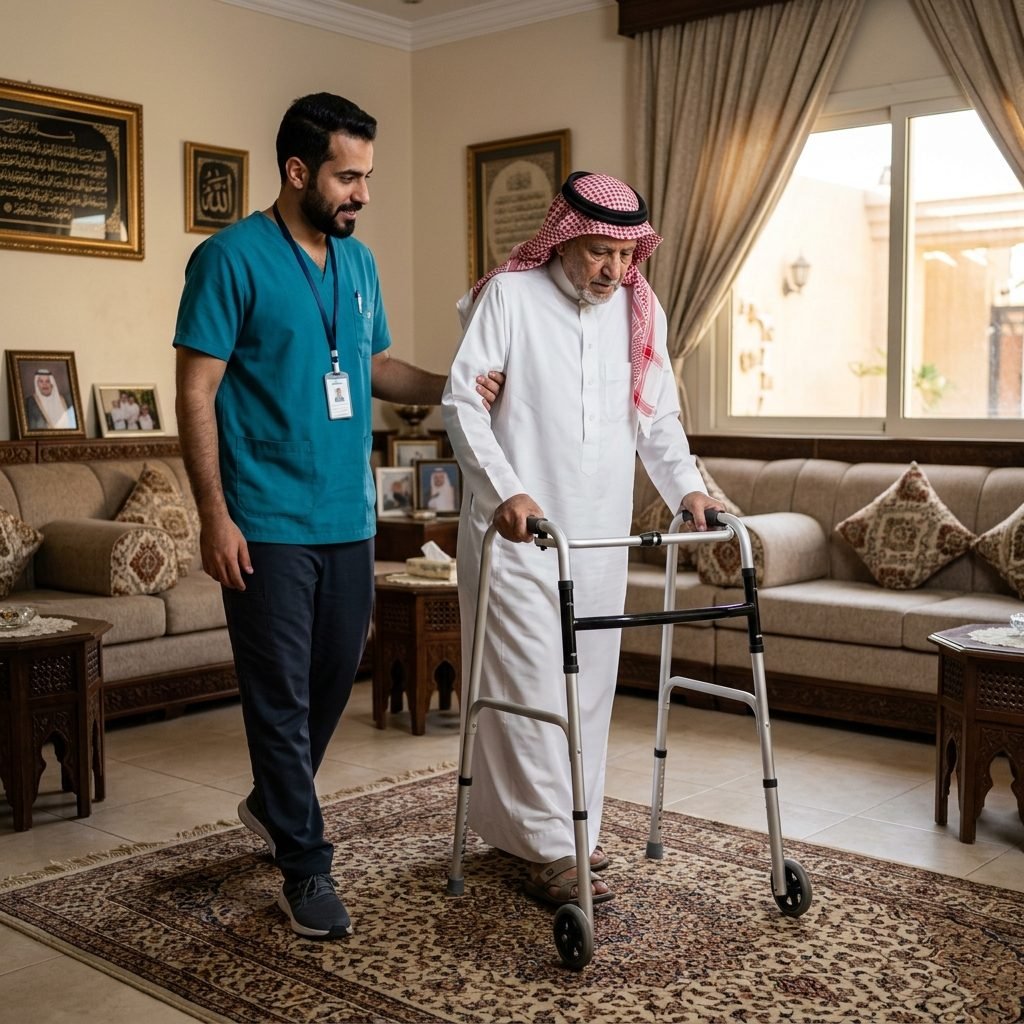
Geriatric Physical Therapy
Balance training, strengthening, and fall prevention for seniors in Al Khaldiyah.
Service Details ←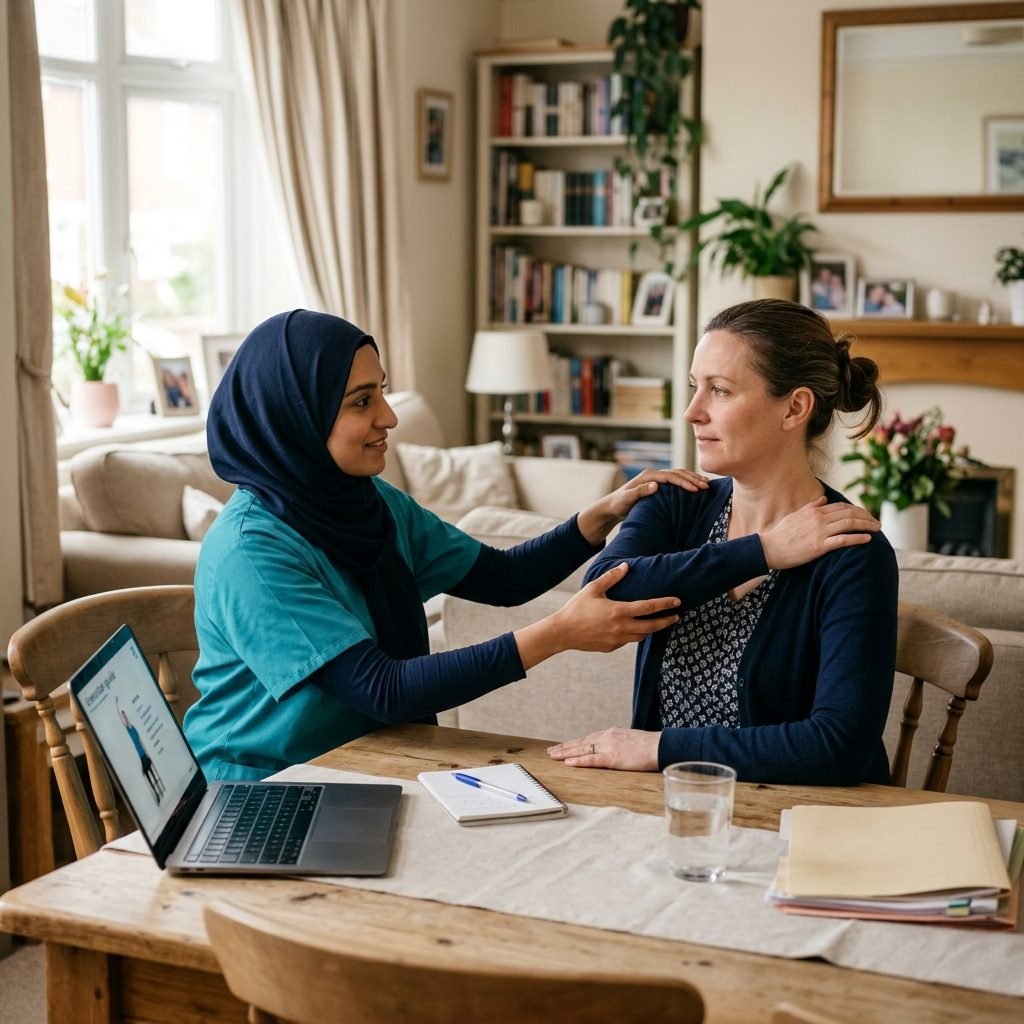
Female Physiotherapist
Licensed female therapists providing home care for women in Al Khaldiyah.
Service Details ←